


15 October 2026
The future of brand voice: Finding your voice
The choice that businesses now have when it comes to 'finding their voice' is immense.
There’s now a genuine spectrum of options available, all crafted in their own unique way and suited for different purposes. Technology hasn't just added new choices, it's changed the equation altogether, and getting that choice right matters more than ever.
Broadly speaking, there are three types of voice that a business can use and adopt:
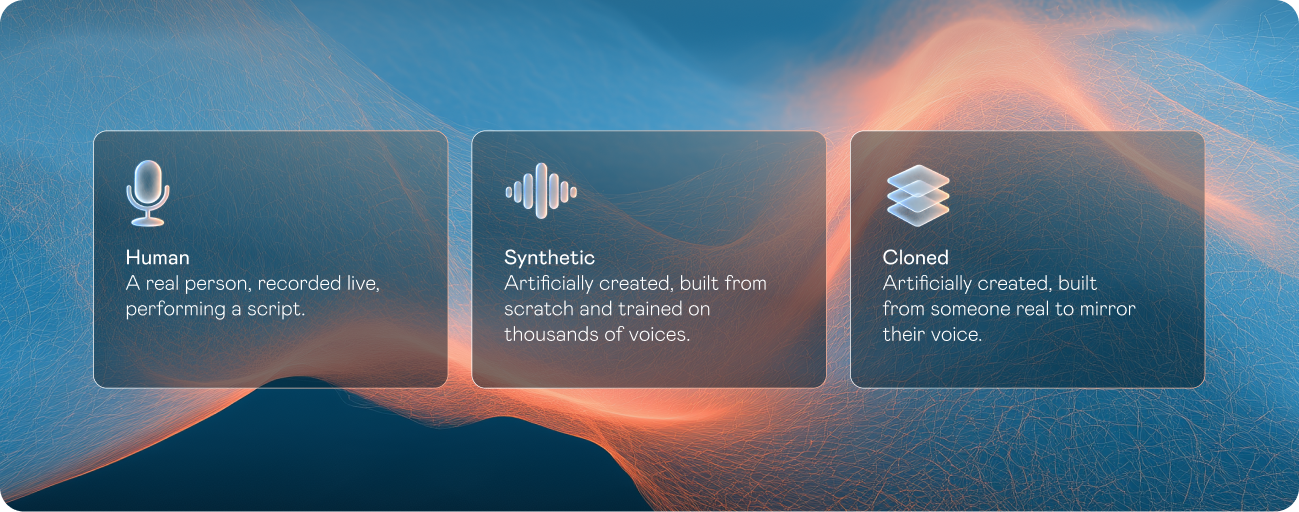
Each is distinctively unique and suited to different environments – here’s how they compare and where, as well as for who, they’re most effective.
What is human voice?
Human voice is exactly what it sounds like – a real person, recorded live, with no model, training data or generation involved. Simply a voice artist performing a script.
There’s a misconception around human voice being simple to get right though. Casting the right voice artist is a genuine skill, and the difference between a voice that fits a brand and one that merely reads its script comes down to tone, pace, warmth and the tiny inflections a good performer brings. It’s a level of nuance that, for now, no AI voice can fully replicate.
So, what should your brand sound like?
There’s no universally “good” brand voice.
A voice that’s perfect for a discount supermarket would feel completely wrong for a luxury hotel. The reassuring tone that suits an accounting firm can’t capture the energy of a sports brand.
The goal isn’t just to sound good. It’s to sound like your brand and capture its very essence.
Take Adidas and Rawlings. Adidas’ voice is energetic, motivational and direct; Rawlings’ is confident, authentic and grounded in heritage. Both sound like themselves. And importantly, they don’t sound like each other.
Accent, tone, pace, rhythm, personality and delivery all contribute to the impression a voice creates. Individually, those decisions may seem small. Together, they create something much more valuable: a recognisable way for a brand to speak.
Where is human voice best used?
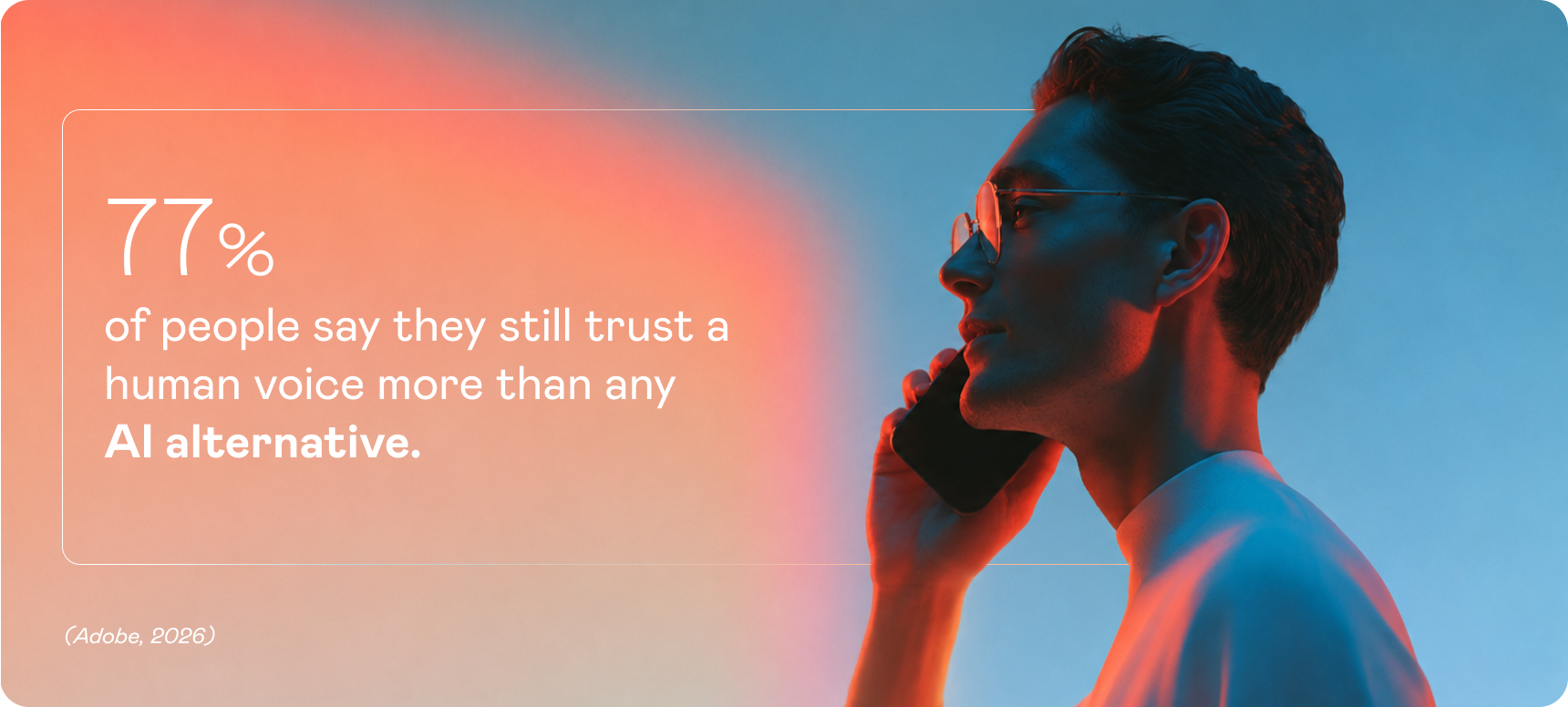
Human voice earns its place in moments that need to feel unmistakably real: flagship campaigns, high-trust conversations like financial advice, funeral services or healthcare, and just about any interaction where a business wants its audience to feel spoken to, not processed.
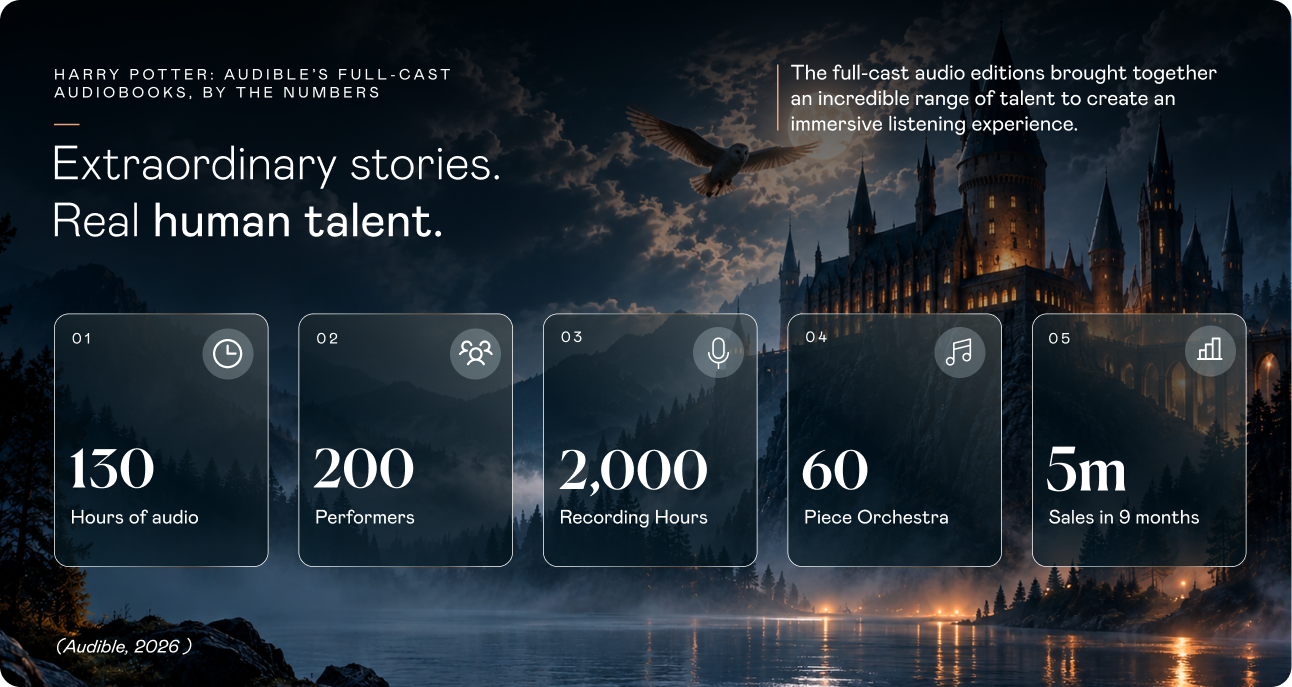
The New York Times has stuck with human narration for its audio journalism, even as competitors automate, and The Economist uses professional broadcasters for its weekly audio edition – something its deputy editor has called ‘a genuinely effective way of keeping readers coming back’. It’s the same instinct behind premium audiobook publishing, where flagship titles – such as the Harry Potter books – are using a suite of recognizable, and highly lauded, suite of screen, stage and voice actors to give listeners an incredibly immersive experience.
What is synthetic voice?
As the name would suggest, synthetic voice is artificially constructed. Unlike human voice, it is not recorded. It is, however, trained on speech from thousands of different speakers before being shaped into something entirely new – a voice that’s never belonged to anyone.
There’s a craft to building one, too. Getting a synthetic voice to sound natural takes careful tuning of tone, pacing and inflection – it’s almost akin to directing a performance, rather than programming a system.

Where is synthetic voice best used?
Synthetic voice is most effective for content that needs to be produced at a scale, and speed, that a studio will struggle to match. From a channel and content perspective, the likes of social media animations and internal updates are all well suited to synthetic voice – particularly if they’re the result of a last-minute ask. If it’s activity that doesn’t need to sound like someone specific, and it just needs to sound clear and consistent, synthetic voice is a fantastic option.
Chess.com turned to AI voice company ElevenLabs to build Dr.Wolf, an in-app coaching tool whose synthetic voice the product team credits with transforming how millions of players learn the game. It now delivers real-time, spoken feedback to every player who requests it, without a voice actor ever needing to be in the room. Content that never stops needs a voice that never has to.
What is cloned voice?
Cloned voice is another form of synthetic voice, but the process of creating it begins with a real person. A model is trained on samples of a real person speaking, who has given their explicit permission for their voice to be cloned, before new speech is generated in their voice.
As the name suggests, the likeness is uncanny. What once needed a studio, and hours of recordings, can now be built from minutes, or sometimes even seconds worth, of source audio.
Where is cloned voice best used?
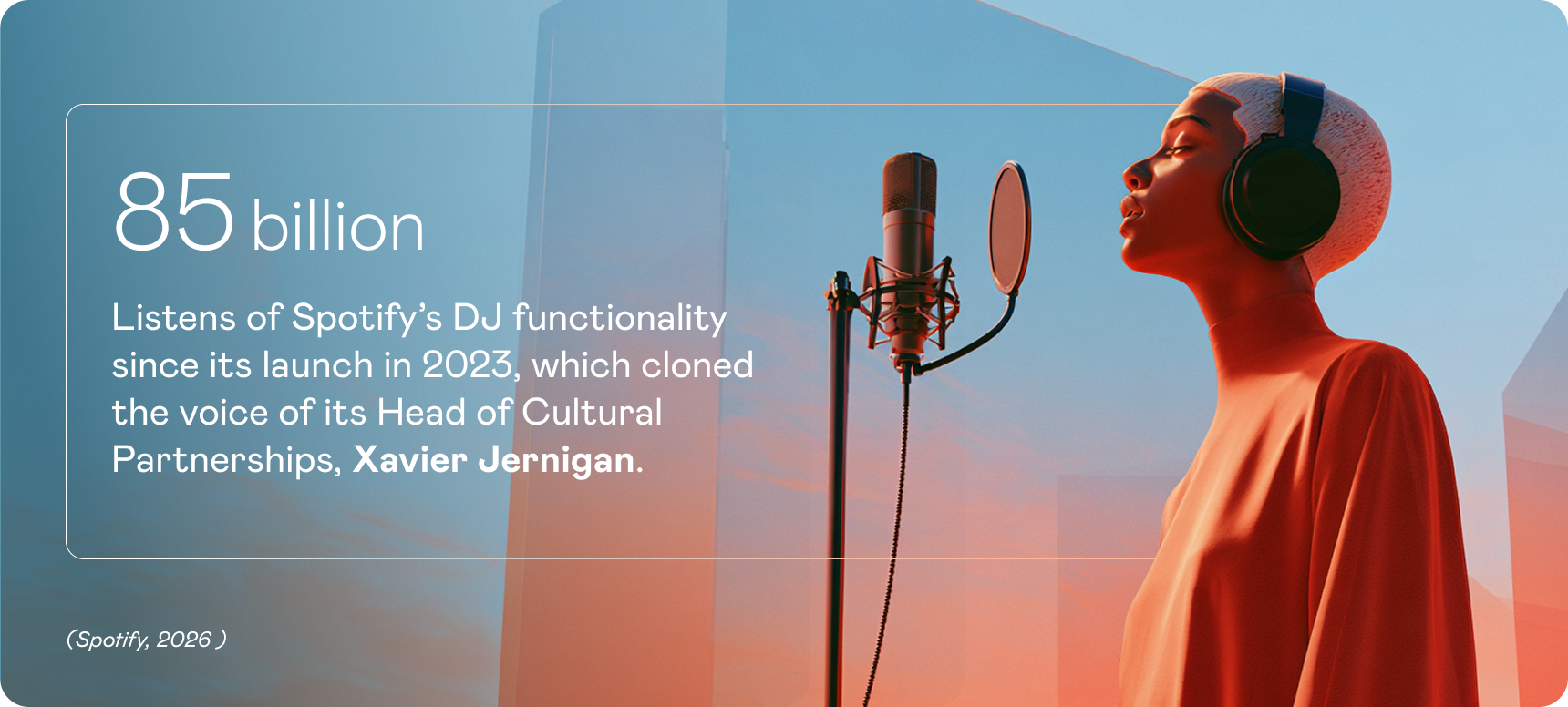
Cloned voice is well-suited to either long-form or high-volume content that still needs to sound like someone specific. Examples include an author reading their own book, a familiar broadcaster’s voice extended across a back catalogue, or a brand ambassador’s voice scaled across thousands of custom messages.
The power of cloned voice has also been evidenced with regards to accessibility and posterity. When Disney needed Darth Vader back for the recent Obi-Wan Kenobi mini-series, the late, great James Earl Jones licensed his archival recordings so that the character could continue. In doing so, it will allow future generations to experience the full force of one of the greatest fictional villains of all time.
Which voice option is best?
The truthful answer is that, when comparing human, synthetic and cloned voice, there is no outright winner. They’re built for different jobs, all have their own unique benefits and the right choice comes down to:
• What you’re saying
• Who you’re saying it as
• How much that moment needs to feel human
Whichever voice you choose, the most important question remains exactly the same: does it sound like your brand?
Already a client?
New to PHMG?

Sources:
- Adobe Express, Voices of AI: Music, Speech and the New Marketing Soundscape, 2026
Voices of AI: Music, speech, and the new marketing soundscape | Adobe
- Global Market Insights, Text to Speech (TTS) Market Size & Share, 2026–2035
Text to Speech Market Size, Share & Analysis Report, 2026-2035
- Deadline: Audible’s ‘Harry Potter’ Full-Cast Audiobooks Conjure Over 5M Sales, 2026
Harry Potter Audible Full-Cast Audiobooks Surpass 5 Million Sales
- Digital music news: Spotify AI DJ expands to more countries, 2026
Spotify’s AI DJ Expands to Premium Listeners in New Markets
Related insights
Trends & opinion
The future of brand voice: Finding your voice
Broadly speaking, there are three types of voice that a business can use and adopt: Each is distinctively unique and suited to different environments – …
Trends & opinion
The future of brand voice: Look good, sound better
Businesses can communicate across more channels than ever before: multi-format advertising, social media, video, telephony, virtual assistants and, increasingly, AI-powered customer interactions. Voice is no …
Trends & opinion
Five ways to make your communications smarter, without losing the human touch
So where does AI create the most value for you? Here are five areas worth considering. 1. Give a better first impression Every customer journey …